








 EnglishGuides
How Similar Is Dutch to English? Closer Than You Think
Introduction
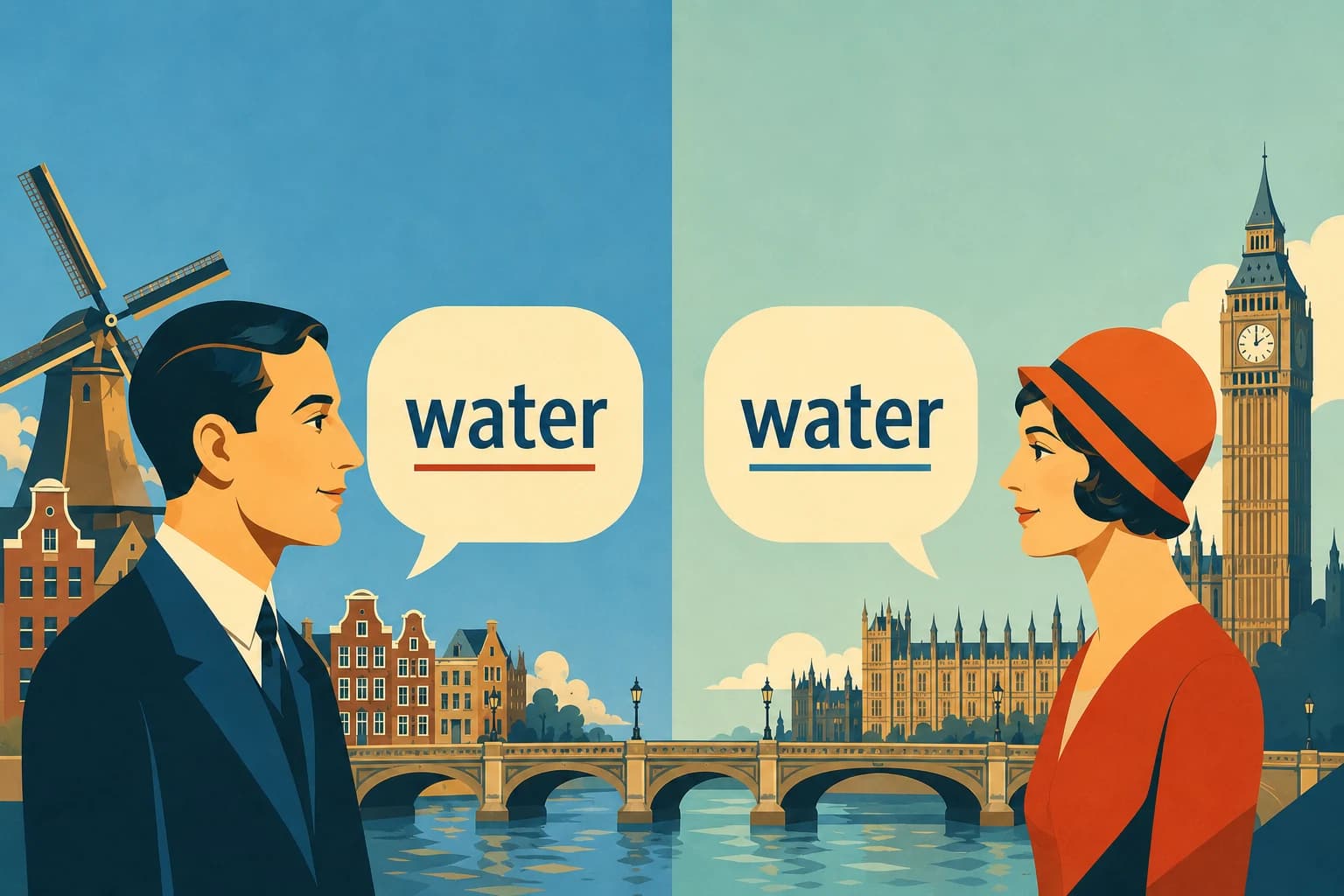
Here's something that surprises most people: if you're a native English speaker, you already "know" more Dutch than you realise. Words like water, hand, man, arm, and land are spelled identically in both languages and mean exactly the same thing. That's not a coincidence – it's family.
Dutch and English are cousins. Both belong to the West Germanic branch of the Indo-European language family, which means they share a common ancestor and, centuries later, still carry the marks of that shared heritage in their vocabulary, grammar, and sentence rhythm.
By the end of this article, you'll understand exactly how similar Dutch and English are, where they diverge, and why that family connection makes Dutch one of the most accessible languages you can pick up as an English speaker.
Table of Contents
- The Family Tree: Why Dutch and English Are Related
- Vocabulary: You Already Know More Dutch Than You Think
- Grammar: Where the Family Resemblance Gets Complicated
- Pronunciation: So Close, Yet So Different
- How Long Does It Take to Learn Dutch?
- Practical Tips for English Speakers Learning Dutch
- FAQ
- Conclusion
The Family Tree: Why Dutch and English Are Related
Think of language families like an actual family photo. Dutch and English are siblings – or at the very least, first cousins who grew up in different houses but still share a lot of the same habits.
Both languages descend from Proto-Germanic, a tongue spoken thousands of years ago across northern Europe. Over centuries, this ancient language branched into North Germanic (Norwegian, Swedish, Danish), East Germanic (now extinct), and West Germanic. Dutch and English both sit firmly in that West Germanic branch, alongside German, Frisian, and Luxembourgish.
Where Frisian Fits In
If you want to get precise, Frisian – a minority language spoken in parts of the Netherlands and northwestern Germany – is actually English's single closest living relative. The resemblance is uncanny: the Frisian phrase bûter, brea en griene tsiis (meaning "butter, bread and green cheese") sounds remarkably like an English speaker talking with an unusual accent.
Dutch sits just one step further on that family tree – close enough that the structural similarities are genuinely useful when you start learning.
Why Did English and Dutch Diverge?
After the Norman Conquest of 1066, English absorbed a massive wave of French and Latin vocabulary, pulling it somewhat away from its Germanic roots. Dutch didn't take that same detour, so it retained many features that Old English once had. This is part of why modern Dutch can feel familiar yet foreign at the same time – you're hearing echoes of what English might have sounded like if history had gone a little differently.
Understanding this shared history is the first step to seeing Dutch not as a foreign language, but as a fascinating reflection of your own.
Vocabulary: You Already Know More Dutch Than You Think
This is the part that makes most English speakers do a double take.
Dutch and English share approximately 60% lexical similarity – meaning that roughly six in ten root words have a common ancestor. In practice, that translates to hundreds of words you can recognise immediately, even on your very first day of study.
Cognates: Your Free Head Start
Cognates are words in two languages that share a common etymological origin – and Dutch is full of them. Here are examples that require zero effort from you:
- water → water
- hand → hand
- arm → arm
- man → man
- land → land
- boek → book (same root, slightly different spelling)
- goed → good (same meaning, pronounced similarly)
- huis → house (that "ui" sound is Dutch, but the root is identical)
- vis → fish (you can hear the family resemblance)
Many everyday Dutch words feel intuitive because they follow the same Germanic patterns English used before the Norman Conquest reshaped its vocabulary.
False Friends: The Cousins Who Will Mislead You
Close relatives can also mislead you. False friends (valse vrienden in Dutch) are words that look or sound similar in both languages but mean something entirely different.
| Dutch Word | What It Looks Like in English | What It Actually Means |
|---|---|---|
| slim | slim (thin) | clever, smart |
| bad | bad (unpleasant) | bath |
| roken | rocking | to smoke |
| trap | trap (snare) | staircase |
| kind | kind (friendly) | child |
| meer | more | lake (though it also means "more") |
| fijn | fine | nice, great, pleasant |
The word trap is particularly entertaining: seeing a trap sign in a Dutch building means you've found the stairs, not walked into an ambush.
Being aware of false friends early protects you from genuinely embarrassing mix-ups – and adds a healthy dose of amusement to your learning journey. The vocabulary overlap is one of your biggest advantages as an English speaker, but grammar is where things get a little more interesting.
Grammar: Where the Family Resemblance Gets Complicated
Dutch grammar shares real features with English, but it also has quirks that will feel genuinely new. The good news: compared to German – which has four grammatical cases and three genders – Dutch is considerably more manageable.
Articles and Gender
English simplified things beautifully: one definite article (the) for everything. Dutch has two: de for common-gender nouns and het for neuter nouns.
- de tafel – the table
- het boek – the book
The frustrating part? There's no tidy rule for which article a noun takes. You largely learn it word by word. That said, roughly 75% of Dutch nouns use de, so when you're genuinely unsure, de is your statistically safer guess.
Word Order: Familiar Start, Unexpected Twist
In main clauses, Dutch follows the same Subject-Verb-Object (SVO) order as English:
Ik drink koffie. – I drink coffee.
So far so good. But in subordinate clauses, Dutch shifts to a verb-final structure:
Ik weet dat jij koffie drinkt. – I know that you drink coffee.
Notice how the verb jumps to the end of the clause? That takes adjustment, but it is a perfectly consistent rule – once you know it, you apply it reliably every single time.
Separable Verbs
Dutch has separable verbs – compound verbs that split apart within a sentence. The verb opbellen means "to call (someone)":
Ik bel je morgen op. – I'll call you tomorrow.
The prefix op- detaches and moves to the end of the clause. It looks chaotic at first, but it follows a predictable logic. German works identically, so if you ever decide to learn German too, this won't surprise you at all.
No Continuous Tense (Mostly)
English loves its continuous tenses: I am running, she was sleeping, they have been waiting. Dutch handles ongoing actions differently. For emphasis, it uses zijn + aan het + infinitive:
Ik ben aan het rennen. – I am running.
In casual speech, though, Dutch speakers often just use the simple present tense, much the same way English speakers might say "I run to work every day."
Dutch grammar is more complex than English in certain places – but nowhere near as demanding as Russian, Arabic, or even German. Most English speakers find the grammar challenging for a few weeks before it starts to click.
Pronunciation: So Close, Yet So Different
You might look at a Dutch sentence and feel confident you can read it aloud. Sometimes you're right. But Dutch has a handful of sounds that English simply doesn't have, and they take real, deliberate practice.
The Guttural G
The most iconic Dutch sound is the guttural G – written as g or ch and produced deep in the throat, similar to the Scottish pronunciation of loch or the Hebrew sound in challah. It appears constantly in Dutch and is almost always the first thing learners struggle with.
The good news: Dutch people are extraordinarily patient about this. They've been listening to foreign attempts for centuries.
The "UI" Diphthong
The Dutch ui sound (as in huis – house, or uit – out) has no direct equivalent in English. It's a rounded, gliding vowel that takes some muscle memory to produce naturally. Give yourself time; it does come.
The "IJ" and "EI" Sounds
Both ij and ei in Dutch are pronounced like the English word eye. Once you know this, words like wijn (wine) and zijn (to be / his) become immediately more readable.
What Works in Your Favour
Many Dutch consonants behave exactly like their English equivalents. The s, m, n, l, f, b, p, t, and k sounds all feel familiar from day one. Dutch also has clear, consistent spelling rules – once you learn them, you can read new words aloud with reasonable accuracy. That predictability is a genuine gift.
Pronunciation is the area where Dutch feels most foreign to English ears, but it's also the area where consistent listening and speaking practice pays off fastest.
How Long Does It Take to Learn Dutch?
How similar is Dutch to English? Similar enough that Dutch ranks among the easiest languages in the world for English speakers to learn. The U.S. Foreign Service Institute classifies Dutch as a Category I language, requiring approximately 600–750 classroom hours to reach professional working proficiency – placing it in the same tier as Spanish and Norwegian.
The Foreign Service Institute (FSI) – the organisation that trains American diplomats in foreign languages – has ranked every major language by how long English speakers take to master it. Here's how Dutch compares:
| Language | FSI Category | Approximate Hours | Difficulty for English Speakers |
|---|---|---|---|
| Dutch | I | 600–750 hrs | Very easy |
| Norwegian | I | 600–750 hrs | Very easy |
| Spanish | I | 600–750 hrs | Easy |
| French | I | 600–750 hrs | Easy |
| German | II | 750–900 hrs | Moderate |
| Russian | III | 1,100 hrs | Hard |
| Arabic | IV | 2,200 hrs | Very hard |
| Japanese | IV | 2,200 hrs | Very hard |
Dutch shares its difficulty tier with some of the most popular languages learners choose. The vocabulary head start gives English speakers a genuine advantage that accelerates early progress significantly.
With consistent study and regular speaking practice, many English speakers reach conversational fluency in Dutch within 6–9 months. Full fluency typically takes 1–2 years, depending on how much immersion you build into your routine.
Now that you know what to expect, let's look at how to make the journey as efficient as possible.
Practical Tips for English Speakers Learning Dutch
Knowing that English and Dutch are close is one thing. Putting that closeness to work is another. These strategies are designed to take direct advantage of your English-speaking background.
Lean Into Cognates Early
In your first weeks, build vocabulary deliberately through cognates. Your brain absorbs them quickly because they already feel semi-familiar. Early wins like these keep motivation high during the period when progress can feel slow.
Make a False-Friends List and Actually Use It
Keep a running list of false friends and review it regularly. Getting slim and kind confused in conversation leads to some genuinely puzzling exchanges – and occasionally hilarious ones. Awareness is the entire solution here.
Listen to Dutch Media From the Start
Dutch public media is excellent, and platforms like Netflix carry Dutch-language content with subtitles. Passive exposure trains your ear to Dutch rhythm and pronunciation far faster than textbook exercises alone. Even background listening helps.
Insist on Speaking Dutch
Dutch people speak very good English – almost universally so in the Netherlands. This is wonderful for travel but a genuine obstacle for language learning, because they'll often switch to English the moment you hesitate. Politely hold your ground. Commit to Dutch. It's the only way to build real fluency.
Use Conversation-First Learning Tools
Language apps that centre on real dialogue rather than isolated vocabulary drills are especially effective for Dutch, because the grammar and pronunciation clicks fastest when you encounter it in context. Talkey is built around exactly this approach – you practise actual conversation from your very first session, which means the language starts feeling natural rather than academic far sooner than you'd expect.
FAQ
Is Dutch the closest language to English?
Not quite. Frisian – a minority language spoken in parts of the Netherlands and Germany – is technically the closest living language to English. However, since very few people speak Frisian today, Dutch is the most useful and widely spoken language that's closely related to English. For practical learning purposes, Dutch is as close as it realistically gets.
Can English speakers understand Dutch without studying it?
You'll recognise individual words, especially in writing, but you won't follow Dutch sentences without dedicated study. The grammar structure and pronunciation differ enough to prevent real comprehension. That said, English speakers typically progress through beginner Dutch faster than through any other language outside the Germanic family – the starting point is genuinely higher.
How many Dutch words are similar to English?
Linguists estimate that Dutch and English share approximately 60% lexical similarity, meaning a large proportion of their core vocabulary comes from shared Germanic roots. Everyday words – especially those relating to the body, nature, numbers, and basic actions – are frequently recognisable across both languages.
Is Dutch grammar similar to English grammar?
Partly. Both languages use Subject-Verb-Object order in main clauses, which feels intuitive to English speakers. However, Dutch also uses verb-final order in subordinate clauses, maintains two grammatical genders with separate articles (de and het), and features separable verbs that split apart within a sentence. These take deliberate practice to master.
How long does it take to learn Dutch if you speak English?
According to the Foreign Service Institute, English speakers need roughly 600–750 hours of study to reach professional proficiency in Dutch. With focused daily practice, conversational ability often arrives within 6–9 months. Full fluency generally takes 1–2 years, depending on how much immersion – podcasts, films, real conversations – you incorporate alongside formal study.
What are the trickiest false friends between Dutch and English?
Some of the most deceptive: slim (Dutch: clever, not thin), bad (Dutch: bath, not unpleasant), trap (Dutch: staircase, not a snare), and kind (Dutch: child, not a personality trait). A dedicated false-friends list, reviewed regularly, is one of the most practical things a beginner can build.
Should I learn Dutch or German first if I already speak English?
Dutch is widely considered the easier entry point. It has fewer grammatical cases than German, simpler adjective declension rules, and vocabulary that overlaps more naturally with modern English. German is enormously rewarding and widely useful, but if speed of early progress matters to you, Dutch is the smarter first step – and it also gives you a strong foundation if you later decide to add German.
Conclusion
So, how similar is Dutch to English? More than most people expect – and that similarity is genuinely useful from day one.
Both languages share a West Germanic family tree, a significant overlap in everyday vocabulary, and broadly comparable sentence structure in main clauses. Dutch will still challenge you with its guttural G, its two-article system, and its verb-final subordinate clauses. But compared to almost any other language on the planet, it's a remarkably approachable target for English speakers.
Three things to carry away from this: Dutch and English are West Germanic cousins sharing around 60% of their core vocabulary; the Foreign Service Institute ranks Dutch among the very easiest languages for English speakers to learn; and the main hurdles – pronunciation and false friends – are both highly manageable with the right practice and the right tools.