







 EnglishGuides
Norwegian vs Swedish vs Danish: The Complete Comparison
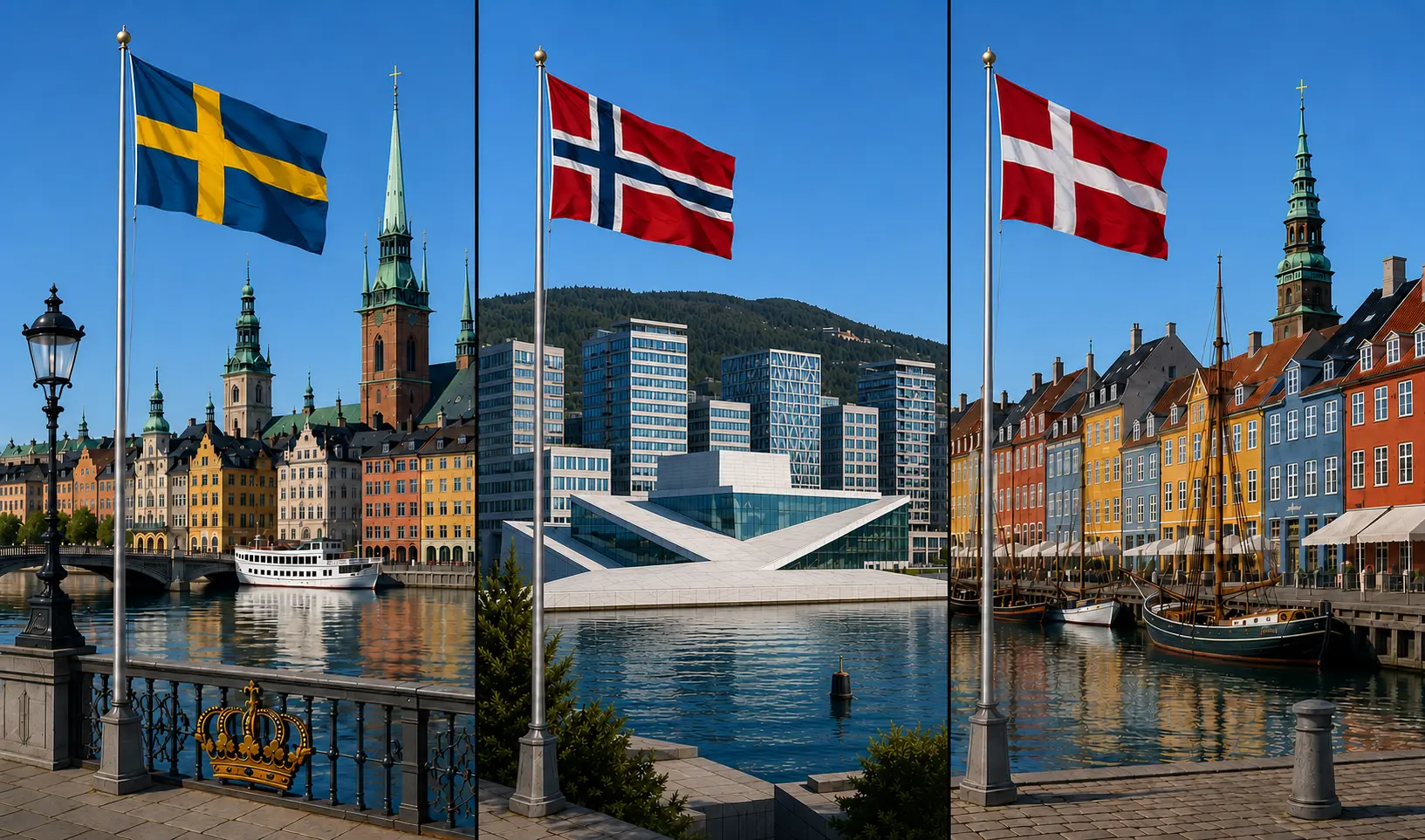
Speakers of Norwegian, Swedish, and Danish can often understand one another – yet in mixed groups across Scandinavia, many people quietly default to English within about fifteen minutes. That one fact tells you almost everything interesting about these languages: they are cousins, not twins.
If you're drawn to Scandinavia and wondering where to start, Norwegian vs Swedish vs Danish is one of the most common questions language learners ask. And it's a good one, because the answer isn't obvious. The three languages share a common ancestor, similar grammar, and enormous vocabulary overlap. They also diverge in ways that genuinely matter – especially once someone opens their mouth.
By the end of this guide, you'll know exactly how these languages compare across history, grammar, pronunciation, vocabulary, and writing systems. You'll also know which one makes the most practical sense for you to learn.
Table of Contents
- A Brief History: Three Languages from One Root
- How Similar Are They, Really? Mutual Intelligibility Explained
- Grammar Face-Off: Key Similarities and Differences
- Pronunciation: Where the Three Languages Truly Diverge
- Vocabulary Comparison: How Different Are the Words?
- Writing Systems, Alphabets, and Spelling
- Which Scandinavian Language Is Easiest for English Speakers?
- Cultural Context: Where Each Language Takes You
- Frequently Asked Questions
- Wrapping Up
A Brief History: Three Languages from One Root
Norwegian, Swedish, and Danish all descended from Old Norse, the language spoken by Vikings across Scandinavia roughly between 700 and 1100 AD. For centuries the differences between regional dialects were small enough that a traveller from Oslo could make themselves understood in Stockholm or Copenhagen without much trouble.
Political history is what pulled them apart. Denmark ruled Norway for over four hundred years, from 1380 to 1814. During that period, written Norwegian was, for all practical purposes, written Danish. That legacy explains why Norwegian Bokmål – the written standard used by around 85–90% of Norwegians today – still looks remarkably similar to Danish. When Norway gained independence and later entered a union with Sweden, the country eventually developed a second official written standard: Nynorsk ("New Norwegian"), reconstructed from rural Norwegian dialects by the linguist Ivar Aasen in the 19th century.
Sweden, meanwhile, followed a more independent path. As a major European power during the 17th and 18th centuries, Swedish absorbed large numbers of French and German loanwords that pulled its vocabulary somewhat away from its cousins.
Knowing this shared ancestry explains why the three languages look so alike on a page – and why spoken reality can feel surprisingly different.
How Similar Are They, Really? Mutual Intelligibility Explained
Norwegian, Swedish, and Danish are mutually intelligible North Germanic languages – speakers can often understand each other without formal study. Norwegian and Swedish speakers understand each other best. Danish is hardest to follow in speech, mainly due to its distinctive pronunciation, even though written Danish and Norwegian (Bokmål) are very similar.
That's the core answer. In practice, though, the picture is more layered.
Written mutual intelligibility is high across all three. Pick up a Danish newspaper and an educated Swedish or Norwegian reader will follow most of it. The shared grammar and overlapping vocabulary make that possible.
Spoken mutual intelligibility is where things get complicated. Norwegian and Swedish speakers generally manage well in conversation – the rhythms and sounds are close enough that most people can follow along with patience. Danish, however, is a different story. Its unique pronunciation (more on that below) makes spoken Danish genuinely difficult for Swedes and Norwegians to understand, even when they can read Danish without breaking a sweat.
Linguists sometimes call this asymmetric intelligibility: Danes often understand Norwegian and Swedish better than the reverse, partly because Danish media is heavily exported across Scandinavia and partly because Danes grow up hearing more of the other two languages than Norwegians or Swedes hear Danish.
The bottom line: all three are related enough that learning one gives you a meaningful head start on the others. But they are not dialects of a single language – they are three distinct languages with their own pronunciation systems, some vocabulary differences, and real gaps in spoken comprehension.
Grammar Face-Off: Key Similarities and Differences
Here's genuinely good news. The grammar of all three languages is, by European standards, refreshingly approachable. No complex case system (looking at you, German), no per-person verb endings (sorry, Spanish), and a sentence structure that feels familiar to English speakers.
Grammatical Gender
This is one area where the three languages have taken slightly different paths.
Swedish and Danish have simplified their gender systems down to two: common gender (called utrum in Swedish, fællesøn in Danish) and neuter. The indefinite article is en for common nouns and ett (Swedish) or et (Danish) for neuter nouns.
Norwegian officially has three genders – masculine (en), feminine (ei), and neuter (et) – but in practice, many urban and eastern Norwegian speakers treat masculine and feminine as a single common gender, just like Swedish and Danish. Rural and western Norwegian dialects, on the other hand, use the feminine gender robustly. This means the Norwegian gender system can feel either like two genders or three, depending on who you're talking to and where.
Verb Conjugation
All three languages share one enormous advantage for English speakers: verbs do not change based on the subject. In English, you say "I eat, you eat, he eats" – that final -s seems small, but Norwegian, Swedish, and Danish don't even bother with it. The verb stays the same for every person.
- Norwegian: jeg spiser, du spiser, han spiser (I eat, you eat, he eats)
- Swedish: jag äter, du äter, han äter
- Danish: jeg spiser, du spiser, han spiser
This makes building sentences dramatically easier than in German, French, or most other European languages.
Word Order
All three follow Subject-Verb-Object (SVO) order, identical to English in its basic form. One important shared rule: in a main clause, the verb must always come second – even if something other than the subject opens the sentence. Linguists call this the V2 rule, and all three languages apply it consistently.
The grammatical similarities between Norwegian, Swedish, and Danish mean that if you learn the grammar of one, the grammar of the others will feel immediately familiar. Where the real differences live is in sounds – and that's where things get interesting.
Pronunciation: Where the Three Languages Truly Diverge
Grammar may unite these languages, but pronunciation is where Norwegian, Swedish, and Danish go their own ways. This is the main reason that Scandinavians don't always understand each other as well as their shared vocabulary might suggest.
Swedish: The Singing Language
Swedish is famous for its pitch accent: a tonal system where the same word can mean different things depending on whether it carries a rising or falling melodic contour. There are two tones, logically called Tone 1 and Tone 2. The classic example is anden – with Tone 1, it means "the duck"; with Tone 2, it means "the spirit." Miss the tone and you've said something unintended.
Swedish also has the sj-sound – heard in words like sjö (lake) and skjorta (shirt) – which doesn't exist in English and requires some dedicated ear training. Regional variation in Swedish is significant, but the melodic, lilting quality of standard Swedish is one of the most recognisable sounds in European languages. Many learners find it pleasant to listen to even before they understand a word.
Danish: The Sound of Swallowed Consonants
Danish pronunciation is, to put it plainly, a challenge. Even Danes joke about this. The defining feature is the stød (stɔ̀ʔ) – a kind of creaky, laryngeal quality that modifies certain vowels and serves as Danish's answer to the tonal accent found in Swedish and Norwegian.
Beyond the stød, Danish is known for "swallowing" its consonants. The soft d (blødt d) sounds somewhere between an English th and nothing at all, and in casual speech entire consonants simply disappear. The result is that written Danish looks quite similar to Norwegian Bokmål – but sounds almost unrecognisable to someone who has only read it on a page.
The phrase rødgrød med fløde (red berry pudding with cream) is a classic Danish tongue-twister used to identify foreigners, and it's become something of a cultural in-joke about how impenetrable the language sounds from the outside.
Norwegian: The Middle Ground
Norwegian sits comfortably between Swedish and Danish in pronunciation. Like Swedish, it has a pitch accent system with two tones. Unlike Danish, it doesn't swallow its consonants – Norwegian speech is generally clear and phonetically consistent.
What makes Norwegian unusual is its dialect diversity. Norway has more pronounced regional dialect variation than almost any other small-country language in the world. The Bergen dialect sounds quite different from Oslo speech, which sounds different again from dialects in Tromsø or the western fjord regions. Norwegian speakers are generally accustomed to this variation and tolerant of it, which makes Norway a surprisingly forgiving place to practise your spoken Norwegian as a learner.
Once you've got a feel for the sounds, it's worth looking at the actual words these three languages use – and how often they agree.
Vocabulary Comparison: How Different Are the Words?
The core vocabulary is strikingly similar across all three languages. Everyday words like house (hus in all three), train (tog in Norwegian and Danish, tåg in Swedish), and friend (venn Norwegian, vän Swedish, ven Danish) show the shared roots clearly. Differences, where they exist, tend to be small spelling or vowel shifts rather than entirely unrelated words.
Here's a direct comparison of common vocabulary:
| English | Norwegian (Bokmål) | Swedish | Danish |
|---|---|---|---|
| Hello | Hei | Hej | Hej |
| Thank you | Takk | Tack | Tak |
| Goodbye | Ha det | Hej då | Hej hej / Farvel |
| Water | Vann | Vatten | Vand |
| House | Hus | Hus | Hus |
| Beautiful | Vakker / Fin | Vacker / Fin | Smuk / Fin |
| Train | Tog | Tåg | Tog |
| To eat | Å spise | Att äta | At spise |
| Friend | Venn | Vän | Ven |
| To want | Å ville | Att vilja | At ville |
Notice how Norwegian and Danish share many identical or near-identical words, while Swedish often diverges slightly – particularly in vowels. The Å, Ä, and Ö in Swedish frequently correspond to Å, Æ, and Ø in Norwegian and Danish. The families are the same; the outfits are slightly different.
One quirk to watch out for: false friends. The Swedish word rolig means "funny" or "fun," but the Norwegian rolig means "calm" or "peaceful." The Swedish fart means "speed"; in Norwegian it means the same thing, while Danish fart also means speed – not what an English speaker's brain leaps to. These overlaps are rare enough not to be a serious obstacle, but they do make early conversations entertaining.
Vocabulary ties closely to the writing systems each language uses – and those are worth understanding before you pick up a textbook.
Writing Systems, Alphabets, and Spelling
All three languages use the Latin alphabet extended with a few extra letters, appended at the end.
- Norwegian and Danish share the same three extra letters – Æ, Ø, Å – in that order.
- Swedish uses Å, Ä, Ö – different letters (Ä instead of Æ, Ö instead of Ø) in a different alphabetical sequence.
This small difference matters in practice. Norwegian and Danish speakers can typically read each other's writing with very high comprehension. Swedish texts, while still largely understandable, carry a slightly more foreign quality – partly because of the different letters, partly because Swedish spelling has drifted further from its Old Norse roots.
Norwegian adds a layer of complexity that Swedish and Danish don't have: two official written standards. Bokmål is used by approximately 85–90% of Norwegians and dominates published media, signage, and official documents. Nynorsk is used by around 10–15%, concentrated in western and rural Norway. Both are legally equal; Norwegian schoolchildren are taught to read both and to write in whichever standard they choose. For a learner, the practical advice is clear: start with Bokmål. But knowing Nynorsk exists means you won't be caught off-guard when you encounter it.
Danish spelling is a special case. It famously lags behind how the language is actually spoken, because Danish orthography reflects older pronunciations that the spoken language has moved away from. This is one of the main reasons the gap between reading Danish and understanding spoken Danish is so wide – a problem that's much less severe in Norwegian or Swedish.
Now that you know how the languages compare on paper and in the air, the obvious question remains: which one should you actually spend your time learning?
Which Scandinavian Language Is Easiest for English Speakers?
The short answer: Norwegian (Bokmål) is the most recommended starting point, and for concrete reasons.
Phonetic consistency is the biggest factor. In Norwegian, what you see on the page maps reasonably well to what comes out of a speaker's mouth. That's enormously valuable in the early weeks of learning, when you need the written and spoken language to reinforce each other.
Strategic position matters too. Norwegian Bokmål sits between Danish (its written ancestor) and Swedish (its spoken neighbour). Learning Norwegian gives you a foothold in all three languages at once – you'll find yourself reading Danish with surprisingly high comprehension and understanding Swedish conversations faster than you'd expect.
Swedish is a close second, and for some learners it's the better choice. It has a larger speaker base – around 10–11 million in Sweden, plus Swedish-speaking communities in Finland where it's an official language. More speakers means more media, more music, more conversation partners, and more learning content. The pitch accent takes adjustment, but Swedish spelling is phonetically reasonable and the grammar is clean and learnable.
Danish is typically rated the hardest of the three, almost entirely because of pronunciation. The grammar is no more complex than Norwegian or Swedish – in many ways it's identical – but the gap between written and spoken Danish is genuinely large, and the stød and consonant reduction require sustained ear training that Norwegian and Swedish don't demand to the same degree.
Here's a full side-by-side overview:
| Feature | Norwegian | Swedish | Danish |
|---|---|---|---|
| Native speakers | ~5 million | ~10–11 million | ~6 million |
| Official written standards | 2 (Bokmål + Nynorsk) | 1 | 1 |
| Grammatical genders | 2–3 | 2 | 2 |
| Tonal / pitch system | Yes (pitch accent) | Yes (pitch accent) | No (stød instead) |
| Pronunciation difficulty | Low–Moderate | Moderate | Moderate–High |
| Written readability for learners | High | High | High |
| Spoken comprehension for beginners | High | High | Moderate |
| Official language in | Norway | Sweden, Finland | Denmark, Faroe Islands, Greenland |
The genuinely good news: whichever of the three you commit to, you're getting roughly 60–70% of the way toward reading the other two for free. That's a return on investment you won't find in many other language families.
Cultural Context: Where Each Language Takes You
A language is never just a set of grammar rules. It's a door into a culture, a literature, and a way of seeing the world.
Norwegian opens access to a country that consistently ranks among the happiest and most liveable on the planet. It's the language of Henrik Ibsen, whose plays helped define modern drama, and the key to Norway's extraordinary landscape – fjords, midnight sun, and a deep outdoor culture built around the concept of friluftsliv (open-air living as a daily philosophy). If you're drawn to Nordic noir fiction, Scandinavian architecture, or a society built on transparency and egalitarianism, Norwegian rewards you on every level.
Swedish connects you to Scandinavia's most globally prominent cultural footprint. Sweden gave the world ABBA, IKEA, Ingmar Bergman, and an astonishing density of internationally successful music and literature relative to its population. Sweden is also one of Europe's most innovative economies, and Swedish fluency is a genuine professional asset in tech, design, and sustainability sectors. Because Swedish is also an official language in Finland, it opens up a second country alongside the first.
Danish leads you to Copenhagen – consistently rated one of Europe's most exciting and liveable cities – and to hygge, the Danish art of cosy togetherness that has become a global cultural export. Danish literature runs deep (Hans Christian Andersen wrote in Danish), and Danish cinema is internationally celebrated. Denmark's historical and administrative ties to Greenland and the Faroe Islands also make Danish one of the few European languages that gives you cultural access to the Arctic.
None of these worlds is objectively better than another. The question is where you want to go.
Frequently Asked Questions
Can Norwegians, Swedes, and Danes actually understand each other?
Yes, to varying degrees. Norwegian and Swedish speakers generally get on well in conversation – the sounds are close enough that both sides can follow along with patience. Danish is harder for the other two groups to follow in speech, primarily because of its distinctive pronunciation. Written mutual intelligibility is high across all three. In practice, many Scandinavians in mixed groups default to English, which is spoken at a very high level throughout the region.
Is Norwegian or Swedish closer to English?
Both sit at a similar distance from English, since all three belong to the Germanic language family and share a significant portion of core vocabulary. Norwegian is often cited as the single easiest language for English speakers to learn overall, largely because of its phonetic consistency and simple grammar. Swedish is a very close second, with a larger community of learners and more available study material worldwide.
How long does it take to learn Norwegian, Swedish, or Danish?
The US Foreign Service Institute (FSI) classifies all three as Category I languages for English speakers – the easiest bracket. Estimated time to professional working proficiency is around 600–750 hours of study. Conversational confidence typically arrives well before that benchmark, often within 6–12 months of consistent daily practice, especially if you combine structured lessons with real listening and speaking practice.
Are Norwegian and Danish essentially the same language?
No – they're distinct languages, but written Norwegian (Bokmål) and Danish are closer to each other than either is to Swedish, a direct legacy of Denmark's four-century rule over Norway. A Dane can read Norwegian Bokmål with very little difficulty, and vice versa. Spoken, however, they sound noticeably different: Norwegian uses clearer consonants and a pitch accent, while Danish has the stød and its characteristic soft, swallowed sounds.
Which Scandinavian language has the most speakers?
Swedish is the largest, with approximately 10–11 million native speakers in Sweden plus around 300,000 in Finland, where it is a co-official language. Danish comes next at roughly 6 million speakers, and Norwegian has approximately 5 million. By any measure, all three are small languages on a global scale – which is exactly why their mutual intelligibility matters so much to the people who speak them.
Do Norwegian and Swedish use the same alphabet?
Both use the Latin alphabet, but with different extra letters. Norwegian (and Danish) use Æ, Ø, and Å, in that order. Swedish uses Å, Ä, and Ö. The letters Ø and Æ in Norwegian/Danish correspond roughly to Ö and Ä in Swedish – the same sounds, represented by different symbols and filed in a different alphabetical position.
Is Danish really as hard to understand as people say?
Ask a Norwegian or a Swede and the answer is almost always: yes, genuinely. The gap between written Danish and spoken Danish is unusually large. Danes speak at pace, reduce consonants heavily, and use the stød in ways that make the spoken language feel very different from what you'd expect after reading the text. Learners who read Danish well often find that listening comprehension takes significantly longer to develop than it would in Norwegian or Swedish.
Wrapping Up
Norwegian, Swedish, and Danish are three close cousins sharing an ancestry, similar grammar, and large portions of vocabulary – but they've developed distinct personalities, especially the moment someone opens their mouth.
Three things worth taking away: first, the grammar across all three is straightforward by European standards – no complex cases, no per-person verb changes, and sentence structure that English speakers can map onto quickly. Second, pronunciation is where the real divergence lives, with Danish being the steepest ear-training challenge of the three. Third, whichever language you choose, you're automatically gaining a meaningful head start on the other two – that kind of linguistic leverage is rare.