









 EnglishGuides
Best Netflix Shows to Watch for Learning German (2026)
Most people assume learning a language means sitting at a desk with flashcards and a grammar book until something sticks. What fewer people realize is that the average German Netflix episode delivers thousands of words of authentic, emotionally charged language – more exposure than most study sessions, and without the headache.
If you're looking for the best Netflix shows to watch for learning German, you've made a smart call: screen time can absolutely be study time. The key is knowing which shows to pick for your level, how to set up your subtitles, and how to watch in a way that makes the language actually land.
By the end of this guide, you'll have a curated watch list sorted from beginner to advanced, a subtitle strategy that most learners get completely wrong, and a few small habits that separate people who genuinely improve from those who binge Dark three times and still can't order a coffee in Munich.
Table of Contents
- Why Watching German TV Actually Works
- The Subtitle Strategy That Changes Everything
- Best Netflix Shows for Learning German – By Level
- Quick Comparison: All Shows at a Glance
- Three Habits That Turn Watching Into Learning
- Some tips
- Your Next Step
Why Watching German TV Actually Works
The concept behind screen-based language learning is called comprehensible input – the idea, developed by linguist Stephen Krashen, that you acquire language naturally when you're exposed to content just above your current level. Enough familiar material to follow along. Enough unknown words to push you slightly forward.
A well-chosen German show hits that range. You follow the plot. A new phrase appears in a moment of tension. Your brain connects sound to meaning through context rather than through grinding memorization – and that context-built knowledge tends to stick.
What makes it work even better is emotion. When a character in a heated scene snaps "Das kann nicht wahr sein!" ("That can't be true!"), you feel the weight of it. Emotional context anchors vocabulary in a way a flashcard deck genuinely can't replicate.
German TV also teaches something textbooks almost never address: register. That's the gap between how German looks on the page and how it sounds in real life. Real Germans contract syllables, drop word endings in fast speech, and lean on filler words like halt, mal, and eigentlich in ways that formal courses rarely prepare you for. Screen time trains your ear – and eventually, your mouth – to handle German as it actually lives in the world.
Watching good German TV isn't slacking. It's input, and input is how every fluent speaker got where they are.
Before we get to the show list, though, there's one thing almost everyone does wrong – and fixing it will double the value of every hour you spend watching.
The Subtitle Strategy That Changes Everything
Here's the most common mistake: watching German shows with English subtitles and counting it as study time. It isn't. Your brain will always default to the easier language – English – and the German audio becomes background noise you stop actively processing within minutes.
Use the subtitle ladder instead:
Stage 1 – Beginner to Intermediate: German audio + German subtitles. Your eyes and ears reinforce each other. You'll catch far more than audio alone would give you, and you'll start to connect how words sound with how they're spelled.
Stage 2 – When a Scene Confuses You: Pause. Find the word or phrase that blocked your understanding. Don't translate everything – just the things that stop the meaning from landing. Replay the scene once with that knowledge in place.
Stage 3 – Intermediate to Advanced: German audio, no subtitles. You'll miss things. That's fine. The brain gradually learns to fill gaps more intelligently, and moments of confusion become the engine of improvement.
One tool worth knowing: Language Reactor (a browser extension, formerly Language Learning with Netflix) overlays German subtitles with hover-over definitions directly in the Netflix player. It's genuinely useful at the intermediate stage for building vocabulary in context rather than from a word list.
Reserve English subtitles for when you're sick, exhausted, or facing a dialect so thick you need a reality check. Don't make them your default.
Now, to the actual shows – here's exactly what to watch, and when.
Best Netflix Shows for Learning German – By Level
🟢 Beginner Level
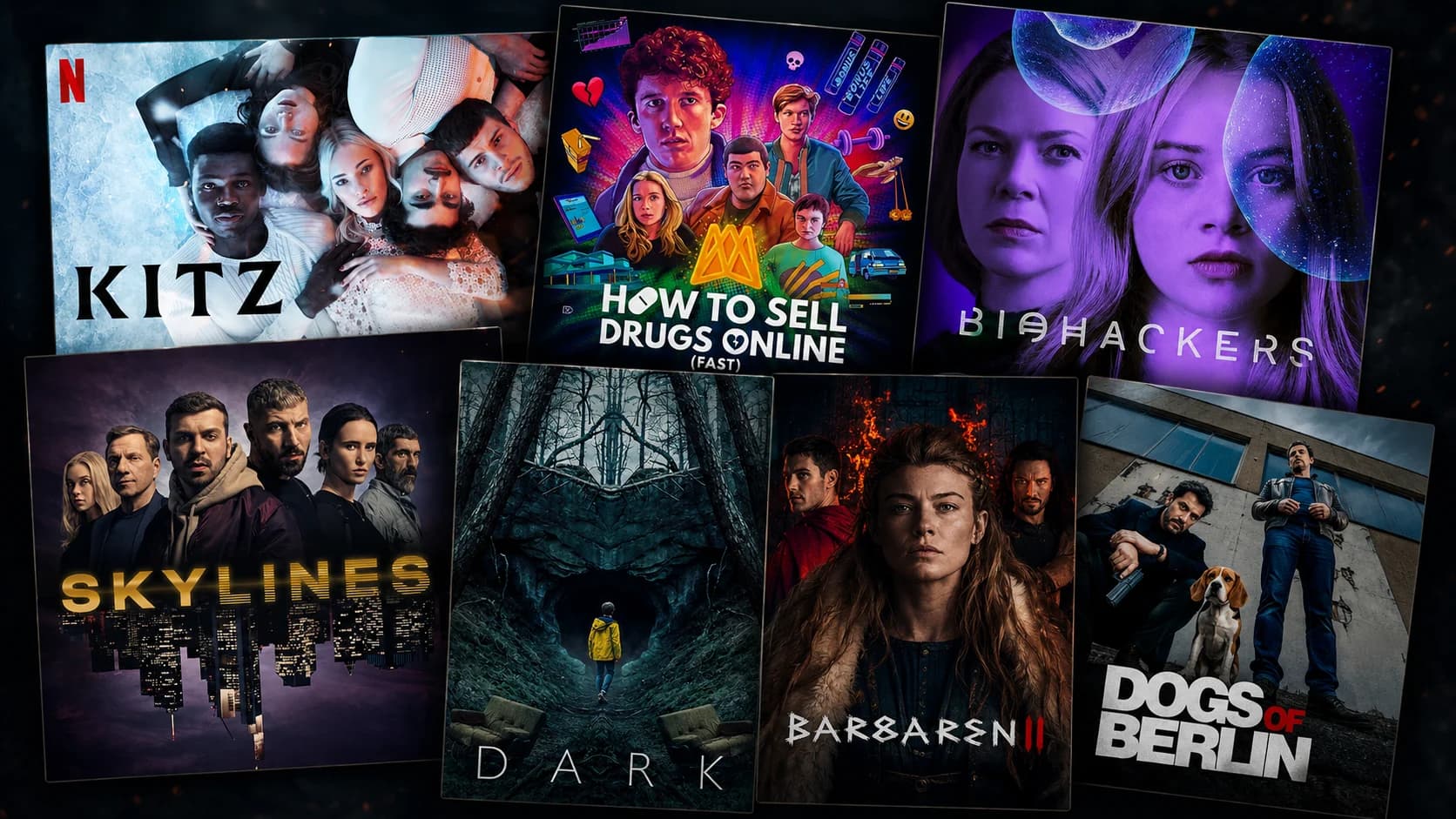
The best Netflix shows for absolute beginners learning German are Kitz and dubbed versions of shows you already know well. Familiar storylines cut cognitive load, freeing your brain to focus on new sounds and vocabulary instead of tracking an unfamiliar plot from scratch.
Kitz is a teen drama set in the Austrian Alps – sleek, contemporary, and built around social dynamics that are easy to follow even when your comprehension slips. The dialogue is conversational, the pacing is accessible, and recurring phrases give you natural repetition without feeling repetitive. Worth noting: some characters speak with a light Austrian inflection, which is good ear-training, but worth being aware of if you're targeting Standard German first.
The dubbed-familiar-shows trick is arguably even more powerful: take something you've already seen in English – Stranger Things, Squid Game, The Crown – and rewatch it with German audio and German subtitles. Because you already know the plot, your brain can put all its energy toward the language itself. It sounds obvious, but it's genuinely one of the most effective strategies a beginner can use.
🟡 Intermediate Level
At this stage, you can follow a basic conversation, but real slang, fast speech, and cultural references still trip you up. These shows will stretch you in exactly the right ways.
How to Sell Drugs Online (Fast) (Wie verkauft man Drogen online (schnell)) is a Netflix Original German comedy-drama – funny, fast-paced, and packed with the kind of casual, slightly chaotic language that younger Germans actually use. The dialogue includes borrowed English terms, internet slang, and conversational contractions all woven together naturally. It's high-energy and genuinely engaging, which means you'll keep watching even when it's challenging.
Biohackers is a science thriller set in Freiburg that mixes academic vocabulary with everyday speech. If you're interested in German beyond tourist phrases – the kind of language used in universities, labs, or professional settings – this show is useful because it asks you to handle both registers in the same sitting. The Hamburg-meets-Freiburg production values are also excellent.
Skylines follows a young music producer navigating Frankfurt's hip-hop scene. The language is informal and urban, the setting is contemporary, and the blend of ambition and street-level German gives you a flavour of the language as it lives in a major city. It's a different register than Biohackers, and both are worth your time.
🔴 Advanced Level
Once you can follow most of a German conversation without reaching for the pause button, these shows will challenge your comprehension of dialects, period language, and layered meaning.
Dark (Dunkel) is the most famous German Netflix Original – a time-travel thriller where characters from multiple decades share the same small forest town. The linguistic challenge is real: the show layers modern dialogue, 1980s German, and formal archaic speech, sometimes within the same episode. For advanced learners, it's one of the richest listening experiences available anywhere. Fair warning: the plot itself demands serious attention, so bring your full focus.
Barbarians (Barbaren) is a historical drama about Germanic tribes resisting Roman occupation in 9 AD. The dialogue is dramatic and rhetorical, with a formality that reflects the subject matter. It's surprisingly gripping and excellent for learners who want exposure to how German sounds when it's wielded with weight and gravitas – the kind of language a history or politics student would benefit from hearing.
Dogs of Berlin is a contemporary crime drama set across the city's socially stratified neighbourhoods. What makes it particularly valuable for advanced learners is the linguistic variety: different characters speak recognizably different German – Turkish-German, polished Berliner, working-class street German – and following that variety trains you to hear the language as it actually differentiates across real communities.
Quick Comparison: All Shows at a Glance
| Show | Genre | Level | Key Vocabulary Focus | Best For |
|---|---|---|---|---|
| Kitz | Teen drama | Beginner | Conversational, everyday | Building basic listening intuition |
| How to Sell Drugs Online (Fast) | Comedy-drama | Intermediate | Youth slang, fast speech | Casual and colloquial German |
| Biohackers | Sci-fi thriller | Intermediate | Scientific + everyday mix | Academic and professional vocabulary |
| Skylines | Music drama | Intermediate | Urban slang, contemporary | Informal urban German |
| Barbarians | Historical drama | Advanced | Formal, rhetorical German | Dramatic and period language |
| Dark | Sci-fi mystery | Advanced | Multi-era speech | Comprehension under real complexity |
| Dogs of Berlin | Crime drama | Advanced | Dialect, sociolect | Regional and community-specific German |
Note: Netflix availability varies by region. All shows listed are Netflix Originals and available in most markets.
Knowing which shows to watch is half the equation. The other half is what you actually do while watching – and that comes down to three habits.
Three Habits That Turn Watching Into Learning
You can binge an entire season and come away with a strong opinion about the plot but essentially no new German. Or you can watch three episodes mindfully and genuinely improve. The difference almost always comes down to three habits.
1. Keep a phrase notebook. When a line confuses you or sounds impossibly fast, pause and write it down in German – not a translation, just the phrase. Come back to it after the episode and try to reconstruct the meaning from context first. This trains inference skills, which are exactly what fluency is built from.
2. Replay one scene before moving forward. The second time through a scene, your brain already knows what's happening, so it can focus entirely on the language. One replay is usually enough to close a comprehension gap that would otherwise stay open. It costs you two minutes and buys you genuine progress.
3. Shadow the dialogue out loud. Choose a character whose speech rhythm appeals to you and repeat their lines – at the same pace, same intonation – right after they speak. It feels awkward. Most people skip it. But it builds speaking intuition in a way that silent watching simply cannot, and it's the fastest route from passive recognition to active production.
Some tips
Can I actually learn German just by watching Netflix?
Netflix alone won't get you to fluency – you'll also need a grammar foundation, vocabulary practice, and time actually speaking. But it's one of the most effective tools for building listening comprehension and absorbing natural speech patterns. Pair it with a structured app like Talkey for daily practice, and the combination is genuinely powerful. Watching works best as one part of a larger routine, not as a replacement for it.
What level do I need to be to watch German shows without English subtitles?
Most learners find that B1 – intermediate level – is around the point where no-subtitles watching starts to feel productive rather than just baffling. Before that, German audio with German subtitles is the smarter setup. You'll understand more than you expect once your eyes can confirm what your ears are hearing. Push toward no subtitles when you find yourself reading ahead of the audio, not just keeping up with it.
Is Dark good for learning German?
Dark is excellent for advanced learners, but it's a demanding starting point for anyone below B2. The vocabulary spans multiple time periods, the sentence structures are complex, and the plot itself demands serious cognitive energy. File it under "watch when ready." It will reward you far more when you're not splitting your attention between following the story and understanding the language simultaneously.
Should I watch German shows with German or English subtitles?
German subtitles are far more effective for language learning. With English subtitles, your brain processes the easier language and largely filters out the German audio. German subtitles keep your attention anchored to what you're trying to learn – you hear a word, see it written, and the meaning clicks in context. Start with German subtitles and gradually work toward no subtitles as your comprehension grows.
What is the easiest German Netflix show for beginners?
Kitz is a strong starting point – modern dialogue, accessible storylines, and a consistent setting that builds recurring vocabulary organically. An equally effective strategy is watching a show you already know well (like Stranger Things) with German audio and German subtitles: your brain can direct all its energy toward the language rather than tracking an unfamiliar plot. For absolute beginners, the familiar-show approach often produces faster early progress.
How much German TV do I need to watch to improve?
Consistency matters more than volume. Thirty focused minutes daily – with a phrase notebook, one scene replay, and the German subtitle setup – will move your comprehension faster than a four-hour weekend binge you half-absorb. Think of it the way you'd think about exercise: frequency and form matter more than raw time. The habit you can keep going is the one that actually compounds.
Can dubbed shows help me learn German, or should I stick to original German content?
Dubbed shows can help at the beginner stage – any German audio is useful when you're training your ear from scratch. But originally German content is better in the long run. Dubs are designed to sync with lip movements from another language, which sometimes makes the rhythm feel slightly unnatural. German-language originals sound more authentic, and the cultural context woven into the language is richer and more coherent.
Your Next Step
Here's what this guide comes down to: the best Netflix shows to watch for learning German are the ones that sit just above your current level, watched with German subtitles, with one small active habit alongside – a phrase notebook, a scene replay – that turns passive exposure into real progress.
Start with Kitz if you're a beginner. Graduate to How to Sell Drugs Online (Fast) as your German grows. Save Dark for when you want to be properly challenged.
Three things worth carrying forward: pick your level honestly, use German subtitles instead of English, and make your watching active in some small way. German doesn't need to feel like a mountain. With the right shows and the right approach, it can feel like a Tuesday night in front of something genuinely good.